
For the past two years, the big AI companies have been promising us “agentic AI” assistants that don’t just answer questions, but actually do things on your behalf. Schedule the meeting. Send the email. Book the flight. Check the price. Run the report.
The promise has mostly stayed a promise. Until now.
Meet OpenClaw: “AI with hands”
OpenClaw started in November 2025 as a hobbyist project by Austrian developer Peter Steinberger. Within weeks, it had become one of the fastest-growing open-source projects in GitHub history. The reason is simple: it works in a way that mainstream AI tools still don’t.
Where tools like ChatGPT respond to your questions, OpenClaw responds to your world. It runs locally on your own machine — your laptop, a home server, or a cloud environment you control — and connects to the apps and services already woven into your workday. WhatsApp, Telegram, Slack, Discord, Gmail, Google Calendar. Wherever you are, it’s there.
But the real difference is what it does when you’re not looking. OpenClaw runs a continuous background loop, proactively checking emails, monitoring websites, updating your to-do list, and flagging anything that needs your attention, without being prompted every time. It’s less a chatbot and more a member of staff that never sleeps.
What it can actually do
The range of tasks people have already put OpenClaw to work on tells you a lot:
Inbox management: reading, summarising, and drafting replies to emails. Calendar management: adding, modifying, and alerting on appointments. Web research and price monitoring: checking flight costs, tracking product availability, surfacing news. Task automation: running shell commands, scraping data, and deploying code. Even smart home control via Home Assistant integrations.
A “skills” system, essentially a plugin architecture, means the community can continuously extend what it’s capable of. Someone has built a skill for Obsidian notes. Another for GitHub repositories. If it doesn’t exist yet, OpenClaw can, in some cases, write the code for the integration itself.
The result is an assistant with memory (it stores your preferences and context as plain-text files on your machine), a personality shaped by how you use it, and the ability to act, not just advise.
The catch: real power, real risk
This is where things get serious. The same depth of access that makes OpenClaw powerful makes it dangerous if misconfigured. Because it can read your files, send emails on your behalf, run commands, and browse the web, a malicious instruction slipped into an email it reads, a technique called prompt injection, could trick it into doing something harmful. Unvetted community plugins can carry risks. And if your OpenClaw instance is accidentally exposed to the internet, someone else could effectively be in control of your machine.
Security experts recommend running it in an isolated environment,a virtual machine or a container, rather than directly on your main computer. The project team has been actively hardening the codebase and releasing machine-checkable security models, but they’re honest: prompt injection is an unsolved problem across the industry.
Where NVIDIA comes in
This is exactly the gap NVIDIA stepped into at its GTC conference this week. NemoClaw is their answer: a business-grade version of OpenClaw that wraps it in an isolated sandbox, adds policy controls for what the agent can and can’t do, and routes personal data through a privacy layer that keeps it local. It’s still an early-stage alpha release and requires technical setup, but the message it sends is significant.
NVIDIA, the world’s most valuable company, is betting that autonomous AI agents will reshape how businesses operate. Whether you see OpenClaw as a curiosity or a genuine workflow tool, the institutional weight behind the underlying technology suggests the question for most organisations isn’t if, but when.
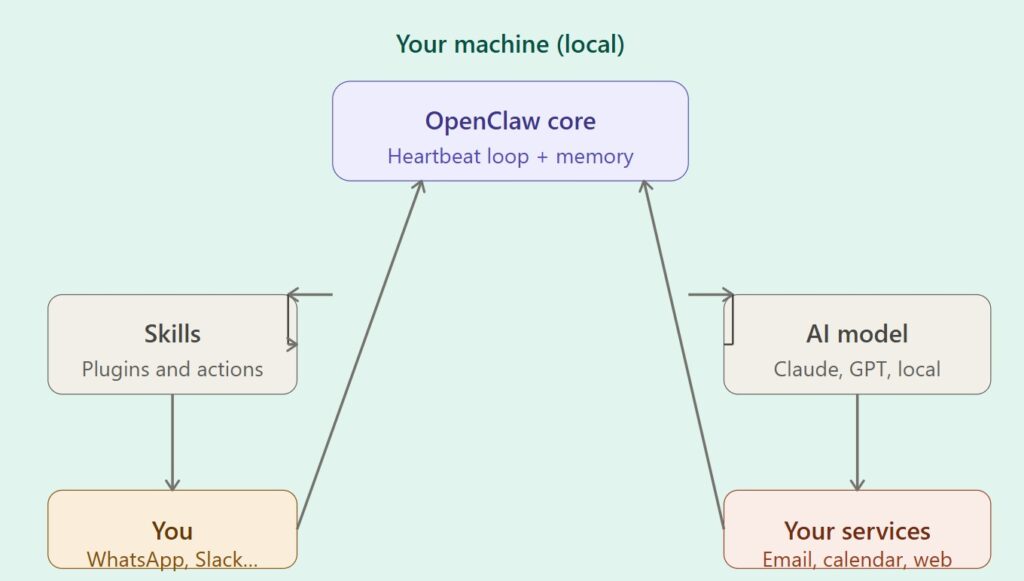
Everything runs on your hardware. You choose which AI model powers it. Your conversations with it happen through apps you already use. Your data stays where you put it.
That’s what makes OpenClaw different, and why even the world’s largest chip company is paying close attention.